
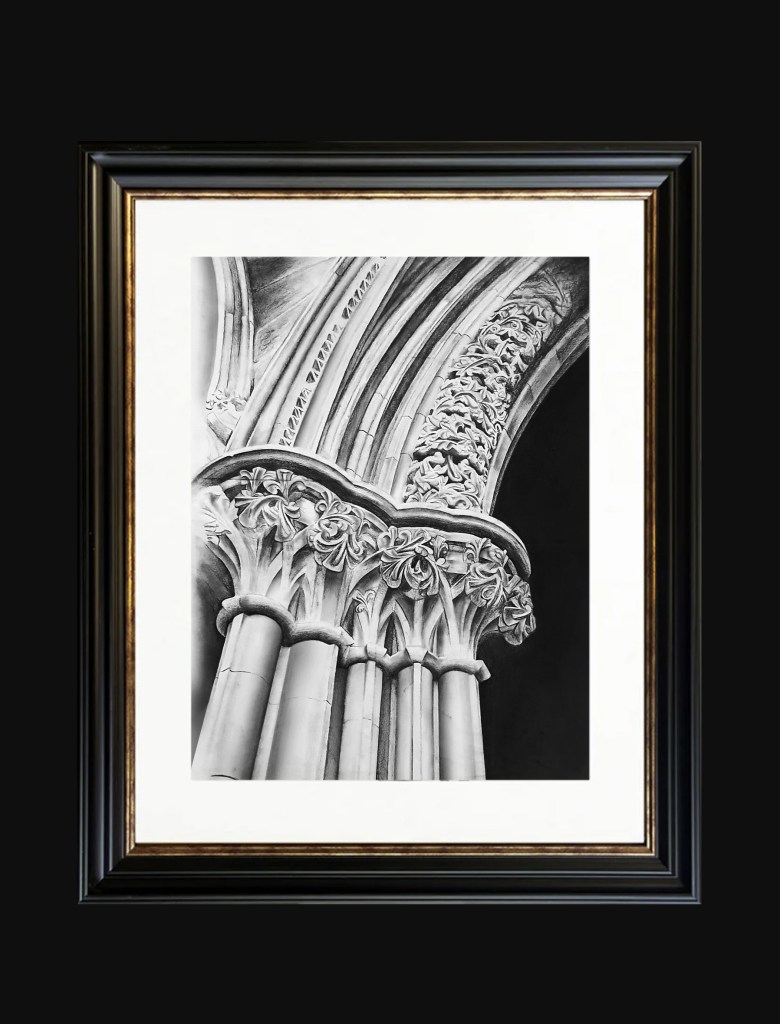
York Minster
York Minster is the second-largest Gothic cathedral of Northern Europe and clearly charts the development of English Gothic architecture from Early English through to the Perpendicular Period. The present building was begun in about 1230 and completed in 1472. York Minster is the largest cathedral completed during the Gothic period of architecture, Cologne Cathedral only being completed in 1880, after being left uncompleted for 350 years. It has a cruciform plan with an octagonal chapter house attached to the north transept, a central tower and two towers at the west front. The stone used for the building is magnesian limestone, a creamy-white coloured rock that was quarried in nearby Tadcaster. The Minster is 524.5 feet (159.9 m) long[3] and the central tower has a height of 235 feet (72 m).[3] The choir has an interior height of 102 feet (31 m).[citation needed]
The north and south transepts were the first parts of the new church to be built. They have simple lancet windows, including the Five Sisters in the north transept. These are five lancets, each 16.3 metres (53 ft) tall and five feet wide[42] and glazed with grey (grisaille) glass,[43] rather than narrative scenes or symbolic motifs that are usually seen in medieval stained-glass windows. In the south transept is a rose window whose glass dates from about 1500 and commemorates the union of the royal houses of York and Lancaster. The roofs of the transepts are of wood; that of the south transept was burnt in the fire of 1984 and was replaced in the restoration work which was completed in 1988. New designs were used for the bosses, five of which were designed by winners of a competition organised by the BBC’s Blue Peter television programme.
Work began on the chapter house and its vestibule that links it to the north transept after the transepts were completed. The style of the chapter house is of the early Decorated Period where geometric patterns were used in the tracery of the windows, which were wider than those of early styles. However, the work was completed before the appearance of the ogee curve, an S-shaped double curve that was extensively used at the end of this period. The windows cover almost all of the upper wall space, filling the chapter house with light. The chapter house is octagonal, as is the case in many cathedrals, but is notable in that it has no central column supporting the roof. The wooden roof, which was of an innovative design, is light enough to be able to be supported by the buttressed walls. The chapter house has many sculptured heads above the canopies, representing some of the finest Gothic sculpture in the country. There are human heads, no two alike, and some pulling faces; angels; animals and grotesques. Unique to the transepts and chapter house is the use of Purbeck marble to adorn the piers, adding to the richness of decoration. The chapter house exhibits the influence of Saint-Urbain, Troyes in the tracery in the vestibule, while the stalls are enlarged versions of the archivolt niches in the portal of Notre-Dame de Paris.[44]
The nave was built between 1291 and c. 1350 and is also in the decorated Gothic style. It is the widest Gothic nave in England and has a wooden roof (painted so as to appear like stone) and the aisles have vaulted stone roofs. At its west end is the Great West Window, known as the ‘Heart of Yorkshire’, second-largest among the church’s 128 windows.[45] This window was designed and built along with the rest of the west front by the master mason Ivo de Raghton in 1338–39.[46] The tracery is in the Flamboyant or Curvilinear Decorated style of English Gothic architecture.[47][46][48] Because of deterioration of stone mullions, the tracery was replaced in the late 1980s with an exact copy.[47]
The east end of the Minster was built between 1361 and 1405 in the Perpendicular Gothic style. Despite the change in style, noticeable in details such as the tracery and capitals, the eastern arm preserves the pattern of the nave. The east end contains a four-bay choir; a second set of transepts, projecting only above half-height; and the Lady Chapel. The transepts are in line with the high altar and serve to throw light onto it. Behind the high altar is the Great East Window, the largest expanse of medieval stained glass in the country, which underwent a decade-long restoration and conservation project, completed in 2018.
The sparsely decorated Central Tower was built between 1407 and 1472 and is also in the Perpendicular style. Below this, separating the choir from the crossing and nave is the striking 15th-century choir screen. It contains sculptures of the kings of England from William the Conqueror to Henry VI with stone and gilded canopies set against a red background. Above the screen is the organ, which dates from 1832. The West Towers, in contrast with the Central Tower, are heavily decorated and are topped with battlements and eight pinnacles each, again in the Perpendicular style.